
Don’t Work Hard, Do the Hard Work
There are a lot of grinders out there working hard, putting in 50, 60, 80+ hours a week for months, years, even decades on end. You know what? I’m not that impressed.
I’m not talking about flurries of business or someone legitimately putting in the hours to make ends meet. My wife and I had several years of working two jobs, digging out of debt, and getting above water. Sometimes we just have to grind it out. I’m picking at professionals who are making a career choice to grind themselves down to a nub. I think it is unwise.
“Don’t work hard? That’s heresy! Are you serious?”
Yeah, I’m serious. I certainly appreciate the fact that our “grinders” are not lazy; anything is better than a sloth. But when it becomes a long-term pattern of behavior, in my observation, working hard does not correlate to efficacy; rather, it is more closely correlated to subpar performance. Here is why: working hard—the “I’m so busy” mentality—typically serves as a clever hiding place from the hard work.
The Wordplay
Let me explain the distinction. “Working hard” is simply putting in the time, while “hard work” is putting time and energy into the most difficult but rewarding things. Hard work is doing the next right thing. The hard work asks and answers the tough questions:
- Who am I?
- What do I want?
- Why do I want it?
- Why is there a gap between what I want and what I have?
- How am I implicit in the circumstances I claim to dislike?
- What do I need to do about it?
The hard work is having tough conversations, including those honest conversations with oneself. Curious, supple, and strong, it requires the sacrifice of sacred cows and the defrocking of albatrosses.
The Critical Few
The Pareto Principle, or 80/20 analysis, is an incredibly powerful tool. When we step back and look at any aspect of life or business, we will find that the overwhelming majority—typically 80% or more—of our outcomes come from 20% of our inputs. This applies to both positive and negative results. This means when it comes to work, 80% of your positive impact comes from 20% of your efforts. As a manager, you will find that 80% of both results and trouble comes from 20% of your team.
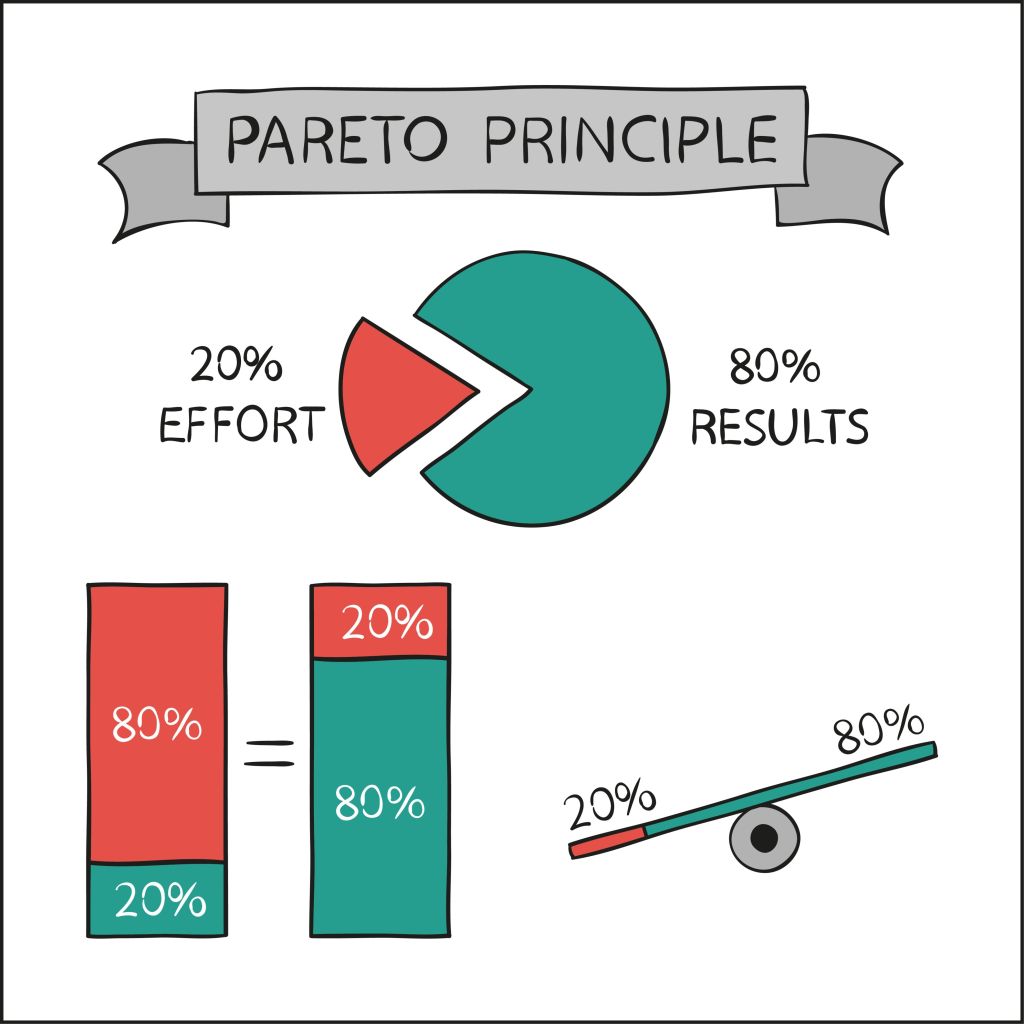
The answer to productivity is actually quite simple: do more of the “critical few” and delete the catastrophic time sucks.
I would take 30 hours a week from someone doing the hard work over a mindless 60 any day. Get off the hamster wheel and look at your career. Where do you add unique value? Do more of those things and figure out how to systematize and delegate the rest. Much of why I have been able to grow in my career as our company has grown is my absolute disdain for repetitive, mindless tasks. Solving the same old problems and doing the same old crap is repulsive to me. Those tasks and problems need to be systematized or given to someone for whom the problem will be new and interesting.
Many of our grinders find comfort in the repetitive. It is very tempting to lock into our narratives and our way of doing things, citing our “experience in the business” as validation for stagnation. As change threatens the mindless grinder, they hunker down and grip their behavioral blankie tight until one day it is ripped from their arthritic hands.
Do the hard work! Determine your most critical and valuable activities and get to work viciously deleting anything that draws you away from those critical few.
What Am I Optimizing For?
So, what is it that I want? We are all building a life; what are we optimizing for? I am exactly where my decisions, habits, and my responses to adversity and fortune have brought me. Whether consciously or unconsciously, the way I live my life is built to bring certain outcomes; it is optimized for certain results.
The mindless grinder loves to talk about how “busy” they are. If your life is optimized for working hard, the question is: why? What is that doing for my ego or my sense of self-importance? What is it that I am trying to avoid by my business? Clever amnesia indeed. The hard work is wrestling with these questions honestly, identifying what I truly want, and then building toward that.
What about Jensen Huang or Elon Musk? These cats work nonstop. To build the largest company in the world, Jensen has worked all day, every day, for his entire life. Whether you like him or not, objectively, Elon is the most innovative world-shaper of our generation. Elon is so consumed with his work that most nights he flops on couches or sleeps on the floor at one of his factories. These guys know exactly what they are optimizing for and have worked hard at the hard work for decades.
So is that the answer? Work tirelessly on the hard work? Well, that depends on what you are optimizing for.
Personally, I wouldn’t—and couldn’t—trade places with either of those guys. First, I am several IQ points short but more importantly I just wouldn’t want to. Jensen has a practice every morning of looking in the mirror and telling himself how much he sucks; he told Joe Rogan in a recent interview that he lives in constant fear of failure. That is how he stays motivated. Elon famously said in an interview, “You don’t want to be me.” He is right, I don’t.
The hard work is not to model these modern tech titans; the hard work is to wrestle with the question: “What am I optimizing for?”
- What do I want to achieve with my career?
- What kind of relationship do I want with my wife and kids?
- Are friends important?
- How do I want to feel and look physically?
- Do I want to grind myself down to a nub in 75 years, or am I aiming for a healthy century?
- Is giving back important?
- Do I believe there is life beyond this one?
- Is this life a prelude to an eternal story? If so, how do I live with that in mind?
I don’t want to be prescriptive here because the hard work is deeply personal, but being a one-dimensional success is not that impressive—or even practical—to me. I love my work; I am passionate about our company and leadership. But I show up better at work when the other areas of my life are vibrant. If I have a fight with my wife, if I’m physically worn, or if I am spiritually dry, I’m no good to anyone at work.
There is a tradeoff to everything. What are we sacrificing? What is the cost of our mindless grinding? Work-life balance at any given moment is a myth, and optimization is not about perfection. The hard work is setting the direction, developing the vision, and maintaining constant course correction based on an honest assessment of what is working and what isn’t.
A Resolute New Year
I’m not big on New Year’s resolutions, but the turning of the calendar is a great time to reset one’s resolve. Before you go back to the routine this January, I urge you to take the time and space to wrestle with the hard questions.
What do I want? What is working? What isn’t working? What tough decisions do I need to make? What do I need to do to move my life and career forward? As I think about this for myself this week I’ve surfaced religious rituals void of relationship, base habits that undermine connection, mindless effort corroding my craft and the service to concerns that should not control me. It’s easy to drift. It is ok as long as we identify it and course correct.
A life of flourishing isn’t found in the volume of our tasks, but in the clarity of our vision. This year, reject the mindless grind and commit to the hard work of answering for the life you are building.
Jim,
You are exactly what I needed.
Thanks!
JW